

This post is outdated. For up-to-date info, see
The January 2010 “Statistical Survey Report on Internet Development in China” was recently published. The report itself is 90 pages long, but here’s what I think you might find most interesting…
Highlights
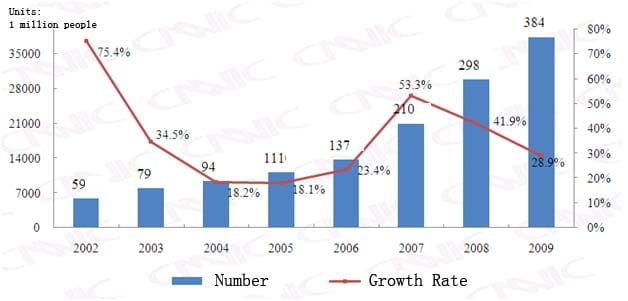
- Now 384 million Chinese internet users.
- Big jump in usage of social networking sites.
- Huge increase in the number of internet users that access the internet via mobile devices.
- Value of online shopping transactions doubles!
User Numbers
ANOTHER YEAR, ANOTHER 80-SOMETHING MILLION INTERNET USERS
The number of Chinese internet users has now reached 384 million. Even though that’s 86 million more than there was last year at this time, that’s only 29% of the total Chinese population so we can expect this rapid growth in internet usage to continue. CNNIC considers an internet user to be anyone on the Chinese mainland over 6 years old that has used the internet at least once in the past 6 months.
Internet usage varies greatly across the different regions of China, in correlation with most other economic indicators such as GDP. In general, usage is highest in the Eastern coastal provinces and lower in the Western interior. Usage in Beijing and Shanghai is already over 60%. Note that Taiwan is included in the map below even though statistics for Taiwan were not included in the report.

Place of Access
MOBILE USERS PUSH FORTH INCREASES IN INTERNET USAGE
The trend of “taking the internet with you” is becoming even more pronounced as seen by the sharp increase in the usage of mobile devices (99% increase) and laptops (42% increase) to access the Internet.
The number of internet users that access the internet via mobile devices has increased 120 million to 233 million. Only 8% of these users are only using a mobile device to access the internet – the other 92% are using a mobile device in addition to a fixed device.
The official release of 3G, more wide-screen and high-speed mobile phones, the network effect of more users coming online, and greater vendor promotion contributed to the quick increase in mobile usage.
Traditionally, one of the most noticeable differences in Chinese internet usage is the place of access – Internet cafes are hugely popular in China. However, this year also saw an increase in internet usage at home (to 83.2%) and at work (to 30.2%).

User Characteristics
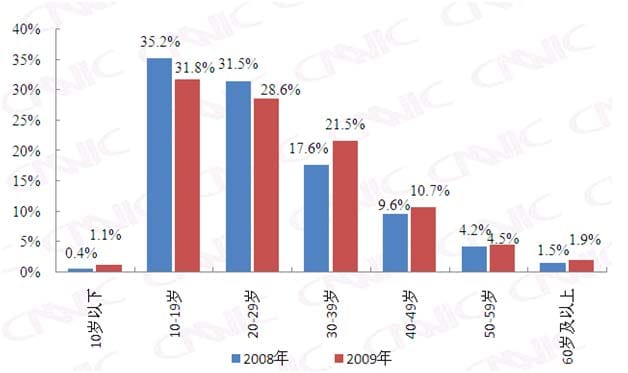
There was an increase in the proportion of users aged 30-39, an age group highly targeted by marketers due to higher disposable income.
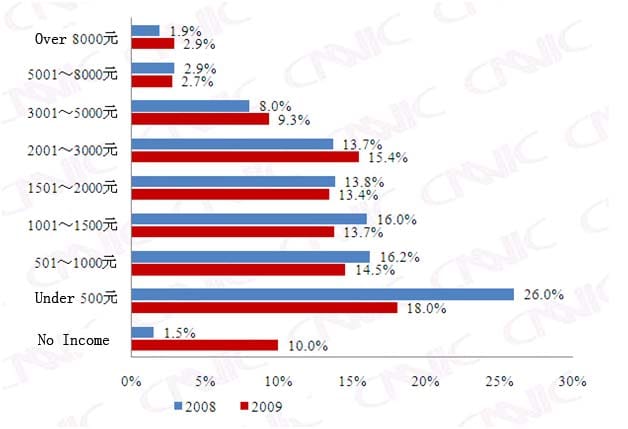
The chart below shows income figures in the Chinese Yuan. One American Dollar is currently worth 6.8 Chinese Yuan.
Usage
More search, more SNS, more shopping!
Based on CNNIC’s usage internet usage categories, the categories with the highest number of users were online music, online news and search engines. Last year’s most commonly used categories were online music, online news and instant messaging.
There are now 280 million search engine users in China, an increase of 39% from last year. More and more, search engines are becoming the gateway to the internet in China. Also, “due to the low-cost of search engine marketing, highly targeted target customers, and their advantage of bringing easily seen marketing results, they are becoming more-and-more trusted by advertisers.” Interestingly, comScore showed an increase of only 13% in the total number of searches performed in China.
There are 176 million users of social networking sites (46% penetration rate.) There’s no rate of increase reported since SNS usage wasn’t recorded last year, but even just two months ago, CNNIC predicted the number of SNS users would be only 124 million at the end of 2009. (See a summary of the SNS report here. The number of forum users has stayed steady at about 120 million users.
Usage of business applications has jumped 68% while usage of online payment has jumped 81%. 108 million online shoppers in China pushed the total value of online shopping transactions in China to 250 billion Yuan (about 36.5 billion USD) – double what it was in 2008!
More
I’m going to be posting a lot more content related to reaching Chinese consumers online, so subscribe!
Click here if you have something to sell to online Chinese consumers.