Chinese Website Translation & Marketing | Nanjing Marketing Group

  • home
  • services
  • knowledge
  • portfolio
  • team
  • contact us

Netizens: Number and Demographics

1) Number of Netizens

(One) Overall Number of Netizens

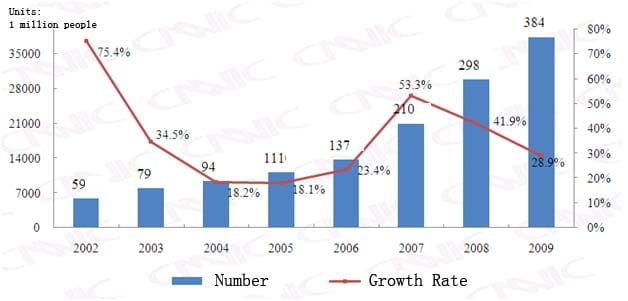
As of the end of 2008, the number of Chinese netizens reached 298 million which is 41.9% higher than 2007. The internet penetration rate reached 22.6% which is higher than the world average of 21.9%1. Since the total number of Chinese netizens surpassed USA’s in June of 2008, making China No.1 in the world, China’s internet penetration rate leaped forward again to meet and pass the world average.
 
The rapid increase in the number of Chinese netizens is closely related to the following factors:
 
Number One) The rapid economic development of my country provides a basis for the rapid expansion of the number of netizens. China has gone through 30 years of reform and opening up.   With a GDP that increased 9.8% this year, China has accumulated considerable strength. Following the increase of overall world income, people will spend more and more time to satisfy their demand for information. At the same time, a good economic environment has created the right conditions for development and innovation in the internet industry. This has prompted mergers within the industry and the advancement of business models, finally resulting in more people becoming netizens and better service for these netizens.
 
Number Two) In order to guarantee the healthy development of information in my country, the country established and published the “National Information Development Strategy for 2006-2020,” “The Eleventh Five-Year Plan for Informationizingt1 Citizen Economic and Societal Development” and other policies. Informationization is currently becoming an important tool in promoting scientific development. Rural IT infrastructure construction has become important and is also gradually becoming an important part of the construction of basic facilities for farms and villages. In order to make information technology benefit the 100 million rural netizens and make sure that the national goal of having “phone and internet for every village” is basically realized by 2010, the relevant government departments and telecommunications operators are working hard to bring phone access to every “natural village” and bring broadband internet to every “administrative village.” Urbanization has created the conditions for even more people to connect to the internet. Urbanization includes two sides: one is the urbanization of villages; the other is the aggregation of cities and villages into clusters. The former directly brings advancement in physical hardware for production and life. The latter further shrinks the divide between cities and villages.
 
Number Three) Communications and network technology have been developing together with broadband and mobile phones. Step by step, data communications are replacing voice communications to become the mainstream of the communications industry. Along with technological developments in the industry and increasing competition between network operators, network access software and hardware is continuously improving. The price of network access products and user terminal products is continuously dropping causing the threshold for users to access the internet to continuously lower. 
 
Number Four) The internet is highly sticky and highly diffusible. According to CNNIC’s investigation, once users come in contact with the internet, the loss rate is very low. Also, online games, instant messaging, blogs, forums, friend-finding applications and other applications are highly interactive. This results in further diffusion of these applications. This diffusion is not only directed at netizens but also those that have not yet used the internet, resulting in the expansion of the number of netizens.
 
Number Five) The increase in the number of netizens raises the value of the internet and this increase in value further increases the number of netizens. According to Metcalfe’s Law, the value of the network is proportional to the square of the number of netizens. In parallel with the rapid increase in the number of netizens, the value of the network continuously inflates. Conversely, those that aim to profit from the internet and user-created content further strengthen the internet’s expandability and attractive power.
 
Although the number of Chinese netizens and the penetration rate continue to develop rapidly, since China has such a large population, the internet penetration rate is only 87th place in the world.
 

(Two) Number of Broadband Netizens

 
The investigation showed that in the 2nd half of 2008, 90.6% of Chinese netizens had used a broadband internet connection. That is, 270 million Chinese netizens used broadband to access the internet, which is over 100 million more than in 2007.
 
Statistics from the Ministry of Industry and Information Technology showed that as of the third quarter of 2008 the number of 2M toll circuits in my country reached 8,935,811, which is almost twice (194%) the number of 2M toll circuits at the end of 2007.  The length of fibre optic cable across the nation reached 6,395,000 kilometres which is 618 thousand kilometres longer than at the end of 2007. The number of broadband access ports reached 103,721,000 including 86,727,000 xDSL ports, which is 22% more than at the end of 2007. The communications ability of my country’s telecommunications network improved rapidly, driving my country’s broadband internet development. The rapid popularization of broadband pushed forward the development of each internet application but my country’s broadband access speed still lags behind that of developed countries.
 

(Three)The Number of Netizens That Go Online via Mobile Phone

 
As of the end of 2008, the number of netizens that accessed the internet via mobile phone reached 117.6 million, which is over twice the number from 2007.
 
The main factors that caused the rapid increase in the number of mobile netizens are as follows:
 
Number one – The significance placed on mobile internet business by operators. Operators at the heart of the business chain have strengthened the management of the mobile internet and gradually lowered the mobile internet access fees for users.
 
Number two – Users of the most popular mobile service, Shenzhouxing, have become the largest group of mobile netizens. As the base of mobile netizens gets larger, the mutual effects between users become more prominent, driving even more users to access the internet via their mobile devices.
 
Number three – Counterfeit phones (usually called “bandit phones”t2) developed rapidly in 2008. These phones provide the basic hardware that allows users to cheaply access the internet via a mobile phone. Along with the arrival of the 3G era, the mobile internet will develop even faster in 2009.
 

(Four) The Number of Rural Netizens

 
As of the end of 2008, the number of rural Chinese netizens reached 84.6 million which is 31.9 million more and 60% higher than in 2007.
 
The rapid increase in the number of rural netizens was boosted by the following factors:
  • First, the promotion of modern distance education by rural Communist Party cadres resulted in the construction of a large number of distance education receiving stations. These stations have pushed forward the development of the internet.
  • Second, the steady progress on the construction of rural information service stations has provided rural citizens with the facilities to access the internet.
  • Third, to accompany the advancement of distance education and the construction of rural information stations, telecommunications operators have provided these areas with fee discount policies, which really pushed forward the internet usage in these areas.
 

(Five) Number of Netizens by Province

 
Chart 1   Number of netizens and penetration rates by province for the years 2007 and 2008
 
  2007 2008 Growth Rate
  Number of Netizens (millions) Penetration Rate Number of Netizens (millions) Penetration Rate
All of China  210  15.9%  298 22.6% 41.9%
Beijing  7.37  46.6%  9.80  60.0%  32.9%
Tianjin  2.87  26.7%  4.85  43.5%  69.1%
Hebei  7.62  11.1% 13.34  19.2%  75.0%
Shanxi  5.36  15.9%  8.19  24.1%  52.8%
Inner Mongolia  3.22  13.4%  3.85  16.0%  19.7%
Liaoning  7.83  18.3%  11.38  26.5%  45.3%
Jilin  4.34  15.9%  5.20  19.0%  19.8%
Heilongjiang  4.76  12.5%  6.20  16.2%  30.2%
Shanghai  8.30  45.8%  11.10  59.7%  33.7%
Jiangsu  17.57  23.3%  20.84  27.3%  18.6%
Zhejiang  15.09  30.3%  21.08  41.7%  39.7%
Anhui  5.87  9.6%  7.23  11.8%  23.1%
Fujian  8.66  24.3%  13.79  38.5%  59.3%
Jiangxi  5.11  11.8%  6.10  14.0%  19.5%
Shandong  12.56  13.5%  19.83  21.2%  57.9%
Henan  9.56  10.2%  12.83  13.7%  34.2%
Hubei  7.06  12.4%  10.50  18.4%  48.7%
Hunan  6.90  10.9%  9.99  15.7%  44.7%
Guangdong  33.44  35.9%  45.54  48.2%  36.2%
Guangxi  5.60  11.9%  7.34  15.4%  31.1%
Hainan  1.44  17.2%  2.16  25.6%  49.9%
Chongqing  3.56  12.7%  5.98  21.2%  67.9%
Sichuan  8.09  9.9%  11.03  13.6%  36.4%
Guizhou  2.24  6.0%  4.33  11.5%  93.4%
Yunnan  3.03  6.8%  5.48  12.1%  81.0%
Tibet  0.36  12.7%  0.47  16.4%  29.5%
Shaanxi  5.17  13.9%  7.90  21.1%  52.8%
Gansu  2.19  8.4%  3.27  12.5% 49.5%
Qinghai  0.60  11.0%  1.30  23.6%  117.4%
Ningxia  0.61  10.1%  1.02  16.6%  66.4%
Xinjiang  3.63  17.7%  6.25  27.1%  72.1%
 
 
The number of netizens in the Western district increased the fastest. Of the provinces with a growth rate of over 60%, 6 of them are in the Western district. The 3 provinces with the highest growth rate are also in the Western district.
 

2) Netizen Demographics

(One) Gender

 
“China Statistical Yearbook 2008” shows that at the end of 2007, China’s proportion of males to females was 51.5:48.5. Compared to 2007, the gender demographics of Chinese netizens further improved. The gender proportion of Chinese netizens approached that of the general population.
 
Although the overall gender distribution of netizens is relatively close, the difference in the gender distribution between urban areas and rural areas is still large. The proportion of male to female netizens in urban areas is essentially equal. However, in rural areas, there are about 15% more males than females.
 

(Two) Age

 
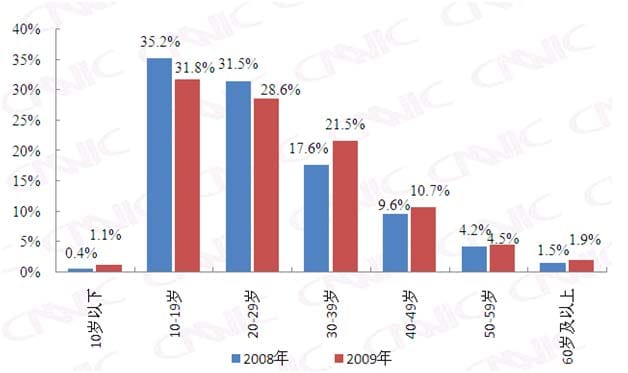
Compared to 2007, the proportion of netizens aged 10 to 19 increased, making this the largest user group by age in 2008. The growth of this group is mainly attributable to two factors. First, the education department started the “Network for Every School” project in 2000 with the plan of allowing 90% of the country’s independently organized schools to access the internet within 5 to 10 years to let the teachers and students share online educational resources. Currently, this program is reaching its end. Second, online entertainment has increased the penetration rate for youth. Online games, online video, online music and other services have all pushed forward the popularity of the internet in this age group. In 2008, the number of netizens aged 40 and over was slightly greater than in 2007. In the past year, the proportion of middle-aged and elder netizens continuously increased. The rate of increase of these netizens already passed the average rate of increase of netizens, showing a trend towards continuous improvements of my country’s netizen age demographics.


(Three) Education

 
Compared to 2007, the proportiont3 of netizens with a college education further decreased while the proportion of netizens with a high school or junior-high school education continued to increase. The internet is becoming more and more popular with less-educated people.
 
Of netizens that are not students, the proportion of netizens that have a junior-high education or less is clearly lower than that of the general netizen population. Also the proportion of non-student netizens with a high school education or higher is clearly higher than that of the general netizen population. In this group, the increase of the penetration rate of less highly educated netizens is clearly lower than that of the student group.
 

(Four) Profession

 
The largest group is students. On one hand, the large number of students greatly invigorates internet usage in China. On the other hand, it reduces the business value of the internet in China.
 
Besides students, party and government organization workers, managers of independent businesses, employees, professional technical staff members and other white collar workers make up a large proportion. Also, rural citizens, who make up the majority of China’s total population, and factory workers still do not make up a large proportion of netizens. Compared to 2007, the proportion of unemployed netizens fell from 11.9% to 5.5%.


1 Source:http://www.internetworldstats.com;Data on the internet penetration rates of other countries and regions.
 
Translator’s Notes
 
  • t1 – In other documents, the Chinese word “信息化” (xìnxīhuà) has been translated as “informationize,” “informatize” and “informationalize.” It is made of two parts: the first is the word “information” and the second is comparable to the suffix “ize.” I would say the definition of “informationize” is “to convert something to a form that uses modern information technology.”
  • t2 - Bandit phones are also called Shanzhaiji or Shanzhai phones.  Shanzhai is used to mean counterfeit, usually for electronics products, but also for anything else from grocery products to celebrities.  This is not the same as "copied" products that look exactly like the original.  Shanzhai products are highly similar but still have their own brand name.  For example, KFG instead of KFC.  For mobile phones, the Star Phone is a shanzhai version of the Iphone.
  • t3 – The original Chinese text actually says that the number of netizens with a college education further decreased. However, that seems so unlikely that I believe it is a typo and what they actually meant to say is that the proportion of netizens with a college education further decreased.


‹ Survey Introduction - Methodology up Fundamental Resources of the Internet ›
  • Printer-friendly version

This is one page of the CNNIC's 23rd report on internet development in China as translated by Nanjing Marketing Group.

CNNIC, which stands for "China Internet Network Information Center," is a Chinese government organization that, among other things, produces reports about internet development in China.

Nanjing Marketing Group provides cross-cultural online marketing, market research and translation services.  Contact.

Services

  • Services
    • Website Translation
    • Search Engine Optimization
    • Pay Per Click Management
    • Website Design
    • Brand Name Translation
    • Free Website Analysis

Knowledge

  • Knowledge
    • Statistical Survey Report on Internet Development in China
      • Report Summary
      • Background
      • Glossary
      • Methodology
      • Netizens: Number and Demographics
      • Fundamental Internet Resources
      • Internet Access Conditions
      • Internet Applications - 1: Basic Usage
      • Internet Applications - 2: Key Groups
      • Internet Applications - 3: Groups by Behaviour
      • Net-Lifestyle Research
    • Search Engine Report
    • Overview of Chinese
  • home
  • services
  • knowledge
  • portfolio
  • team
  • contact us